


When Do You Need a Legal Property Valuation Report?
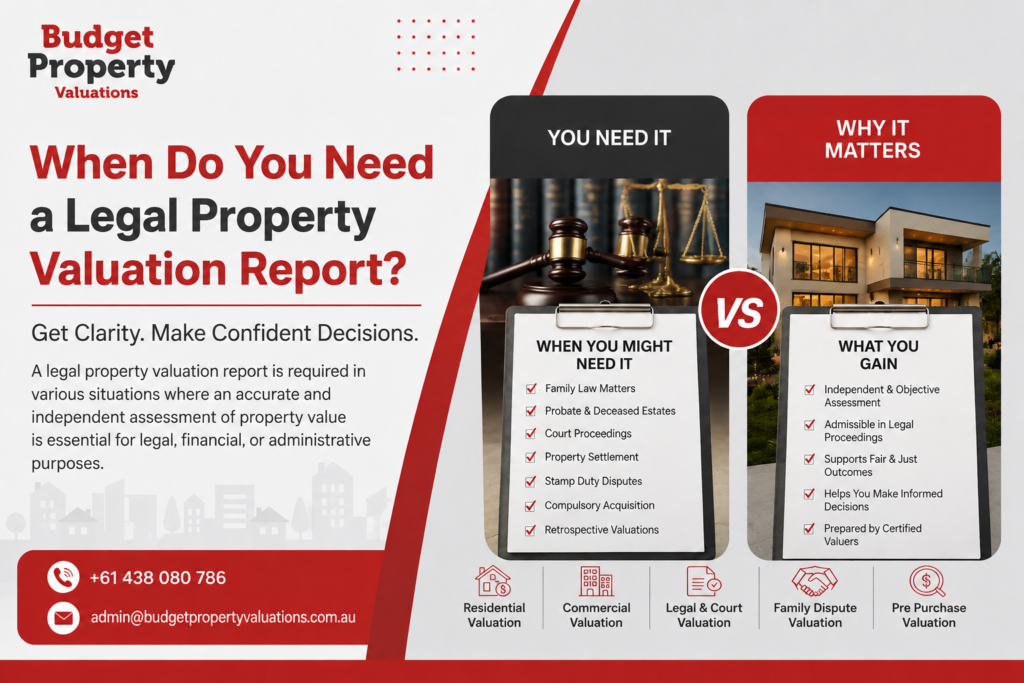
A legal property valuation report may be required when a property’s value becomes a genuinely contested fact rather than a simple figure everyone can agree on. This happens more often than many property owners expect, arising in family law settlements, deceased estate disputes, compulsory acquisition claims, tax office reviews, and other legal proceedings where a court, tribunal or opposing party may require independent, defensible evidence rather than a self-assessed estimate. Understanding when this specific type of report becomes necessary, rather than relying on a standard valuation prepared for finance or insurance purposes, can materially affect how smoothly a legal matter proceeds.
This guide explains what a legal property valuation report involves, the types of legal proceedings across Sydney, Melbourne and Darwin that commonly require one, and what separates a report prepared for legal purposes from an ordinary valuation that may not withstand scrutiny once a matter is formally contested.
SUMMARY
What This Article Covers
This guide explains what a legal property valuation report is and why it differs from a standard valuation prepared for a bank or an insurer. It covers the specific legal proceedings that commonly require one, including litigation, family law property settlements, deceased estate disputes, compulsory acquisition, and tax-related valuation disputes. It also outlines what a compliant legal valuation report must demonstrate, defines the role of the valuer as an independent expert, and answers the questions property owners and their legal advisers ask most often about this type of report.
What a Legal Property Valuation Report Actually Involves
A legal property valuation report is an independent assessment of a property’s value prepared specifically to serve as evidence within a formal legal proceeding, whether that is a court hearing, a tribunal matter, a mediation, or a tax office review. Unlike a standard valuation obtained for a home loan or an insurance renewal, this type of report must set out the valuer’s reasoning, assumptions, and comparable evidence with enough depth that another party, their legal representative, or a decision-maker can properly test and assess the conclusion reached.
The valuer preparing a legal property valuation also assumes a distinct professional responsibility that separates this work from most other valuation engagements. Rather than acting as an advocate for whoever has commissioned the report, the valuer’s overriding duty runs to the court, tribunal, or relevant authority, meaning they must reach an honest, impartial conclusion even where that conclusion does not favor the instructing party. This independence is precisely what gives a legal property valuation genuine evidentiary weight.
Why a Standard Valuation Rarely Survives Legal Scrutiny
A standard property valuation prepared for finance or insurance purposes is typically a comparatively brief document focused on delivering a single figure, without the depth of reasoning a legal proceeding demands. Once a matter becomes genuinely contested, opposing legal representatives will look for any gap in that reasoning, and a report unable to withstand detailed questioning is unlikely to carry significant weight before a court or tribunal.
Legal Proceedings That Commonly Require a Legal Property Valuation
Several recurring categories of legal matter bring an independent property valuer into a formal proceeding, and property owners should understand each one before assuming a standard valuation will suffice.
Family Law Property Settlements
Where separating parties cannot agree on the value of a shared home, investment property, or business asset containing real property, family law property valuations prepared to a proper evidentiary standard give the court, and often the parties themselves during earlier negotiation, a figure that has not been shaped by either side’s negotiating position.
Litigation and Commercial Disputes
Where a property dispute proceeds to litigation, whether over a contract breach, a partnership disagreement, or a contested transaction, an independent legal valuation gives the court a tested, transparent figure to rely on rather than competing, self-interested estimates from each side.
Deceased Estate and Beneficiary Disputes
Where beneficiaries of a deceased estate disagree about the value of a property, particularly where the property has not yet been sold or where a dispute later arises among beneficiaries, an independent legal valuation removes personal opinion from the figure being contested.
Compulsory Acquisition and Compensation Claims
When a government authority compulsorily acquires land, affected owners may be entitled to compensation under the legislation applying in the relevant state or territory. For Melbourne property owners, valuations may be used to assess compulsory-acquisition compensation in Victoria, and disputes may involve different opinions about valuation methodology and the appropriate compensation amount.
Tax Office Reviews and Valuation Disputes
Where the tax office challenges a reported market value used for capital gains tax purposes, or where a valuation for stamp duty purposes is queried by a state revenue office, a properly prepared legal valuation gives property owners a defensible position supported by genuine evidence rather than an unsubstantiated figure.
Easement and Compensation Matters
Disputes over how much an easement reduces a property’s value, whether affecting residential or commercial land, often require an easement valuation expert witness prepared to the same evidentiary standard as any other legal property valuation, particularly where compensation is being negotiated with an acquiring authority.
What a Legal Property Valuation Report Must Demonstrate
Because a legal property valuation may ultimately be tested under direct questioning, the report needs to satisfy a considerably higher evidentiary standard than a routine valuation ever would.
Transparent, Well Supported Methodology
Every assumption, comparable sale, and adjustment applied within the report needs to be explained clearly enough that another qualified valuer, or a decision maker without a property background, can follow the reasoning from the underlying evidence through to the final figure.
Compliance With Expert Witness Requirements
Courts and tribunals generally require expert reports to comply with specific codes covering formal declarations of independence and the expert’s overriding duty to the relevant authority rather than to the instructing party. A valuer genuinely experienced in legal valuation work will already be familiar with these requirements.
A Genuine Willingness to Give Oral Evidence
A legal property valuation report is ultimately only as strong as the valuer’s ability to defend it under questioning. Property owners and their legal advisers should confirm that a prospective valuer is comfortable being cross-examined and has previously given oral evidence in a hearing.
Retrospective Legal Valuations
Many legal matters require establishing a property’s value as at a specific past date rather than the current date, adding a further layer of complexity to the assessment.
Establishing Historical Value for a Legal Proceeding
A backdated property valuation is often needed where a legal matter turns on what a property was worth at a specific earlier point, such as the date of separation in a family law matter or the date of death in a deceased estate, requiring the valuer to reconstruct market conditions from that period using historical sales evidence.
Choosing the Right Valuer for a Legal Property Matter
Selecting an experienced legal valuer early in a matter can materially affect both the strength of the evidence and how efficiently the proceeding moves toward resolution.
Demonstrated Expert Witness Experience
Ask any prospective valuer how many legal property valuations they have prepared previously and whether they have given oral evidence before a court or tribunal, since this experience differs meaningfully from general property valuation work.
Genuine Local Market Knowledge
A valuer with authentic, current knowledge of the relevant market, whether in Sydney, Melbourne, Darwin, or elsewhere, is generally better positioned to identify genuinely comparable evidence and withstand questioning about local market conditions.
When Property Owners Need a Legal Property Valuation Report
● When a family law property settlement cannot be agreed between separating parties
● When a property dispute proceeds to litigation or a commercial disagreement
● When beneficiaries dispute the value of a property within a deceased estate
● When a property is compulsorily acquired by a government authority
● When the tax office challenges a reported market value for CGT or stamp duty purposes
● When an easement dispute requires independent expert witness evidence
● When a court or tribunal specifically orders an independent expert valuation
Frequently Asked Questions
Q: What is a legal property valuation report?
A: It is an independent property valuation prepared specifically to serve as evidence in a formal legal proceeding, setting out detailed reasoning that can be tested by another party.
Q: How is a legal property valuation different from a standard valuation?
A: A legal valuation includes far more detail on methodology and comparable evidence, and must comply with expert witness requirements a standard valuation is never required to address.
Q: Who instructs the valuer in a legal property matter?
A: Legal valuations are usually commissioned through a solicitor acting for one of the parties, or jointly by agreement or court order, though the valuer’s duty always remains to the relevant authority.
Q: Can a legal property valuer be cross examined?
A: Yes. A genuine expert valuer preparing a legal property valuation should expect to be questioned closely on their methodology and conclusions if the matter proceeds to a hearing.
Q: Does a legal property valuation apply to tax disputes?
A: Yes. Where the tax office challenges a reported market value for capital gains tax or stamp duty purposes, an independent legal valuation provides the defensible evidence needed to support the owner’s position.
Q: What is a retrospective legal valuation?
A: It establishes a property’s value as at a specific past date relevant to the legal matter, such as a date of separation or a date of death, using historical sales evidence.
Q: Can easement disputes require a legal property valuation?
A: Yes. Disputes over how much an easement reduces a property’s value often require an independent expert witness valuation to support a compensation claim or negotiation.
CONCLUSION
A legal property valuation report becomes genuinely necessary the moment a property’s value is contested within a formal legal proceeding, whether that involves family law, litigation, a deceased estate, compulsory acquisition, or a tax office dispute. Understanding which of these situations applies to your circumstances helps ensure the right type of evidence is obtained before the matter progresses further.
Engaging an experienced, independent valuer as early as possible in any legal matter gives property owners and their legal advisers across Sydney, Melbourne, and Darwin a defensible position to work from, whatever the proceeding ultimately requires.
Need a Legal Property Valuation? Contact Budget Property Valuations
Budget Property Valuations prepares independent legal property valuation reports for litigation, family law, deceased estates, compulsory acquisition, and tax-related matters across Sydney, Melbourne, and Darwin. Our valuers are experienced in expert witness work and comfortable giving oral evidence when required.
Visit budgetpropertyvaluations.com.au | Australia Wide